





- June 24, 2024
Determining The Right Radar Level Measurement Device for Your Application
In this blog post, Bob Botwinski, Sr. Global Product Manager, discusses how guided wave radar (GWR) and non-contact radar (NCR) can work together to provide reliable level measurement.
The Best Applications For Each Technology
Due to the similarity between GWR and NCR with respect to both performance and capability, there will obviously be some overlap in the application set. Experience, comfort level, and plant-specific standards may dictate a user’s decision as which to use for any given application. However, we all know that “force-fitting” any technology to an application can result in post-installation issues. Therefore, there are some basic application questions that, when considered for a specific application, will quickly guide a user to the proper RADAR technology.
Three basic parameters, considered in this order, can help a user determine the best technology for RADAR level measurement applications:
1. Measurement Range
Since GWR requires the probe to be as long as the measurement range required, NCR is typically more suitable for large storage tank applications with slow moving levels. Shorter range, quicker moving process control applications, such as those in side-mounted chambers, are typically better suited with GWR.

2. Process Conditions (Temperature and Pressure)
Some GWR products have probes that can accommodate maximum temperatures up to 850F (450C) and maximum pressures up to 6250 psi (430bar). Some NCR antennas also have a maximum operating temperature of 850F (450C), but are limited in a maximum pressure rating of 2320 psi (160 bar). Therefore, GWR should be considered for those more difficult high temperature, high pressure applications.
3. Dielectric Constant of the Process Medium
With both GWR and NCR, the dielectric constant (ε) of the process medium dictates the size (amplitude) of the reflection from the surface of the material. High dielectric media like water (ε = 80) produce large reflections that are easily detected by the transmitter. On the other hand, low dielectric hydrocarbons (ε = 1.7 -3) result in low amplitude signals that may be difficult to detect reliably, especially with other adverse conditions like foaming and turbulence.
With the high frequency GWR signal being focused and transmitted down a waveguide, very little energy is lost as the signal travels down the probe. On the other hand, significant signal attenuation can occur with NCR devices in some applications. Being more efficient, GWR is, in general, the preferred technology for low dielectric applications (ε< ~ 2).
It must be stressed again that there can be other, perhaps non-technical, reasons one may choose the technology not meeting the criteria above. However, these three parameters, when considered either separately or together, are a good start in guiding the user to the most robust and reliable solution.
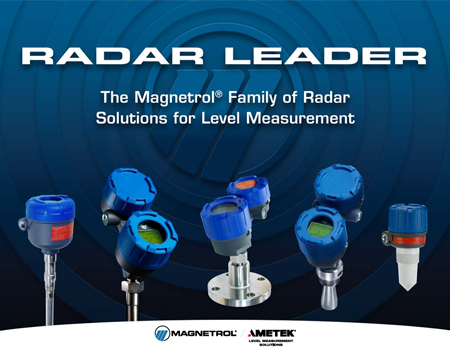
For more information, we have created a Radar Solutions brochure where you can learn more about our radar level measurement technologies.

Radar Solutions Brochure
How can you serve a world of different customers with different applications from different industries?
AMETEK® Magnetrol does it with a true family of radar transmitters for all different needs. This brochure will introduce you to our Eclipse GWR and Pulsar Radar solutions. You’ll learn why the Magnetrol family is trusted wherever and whenever performance, safety and reliability matter.

Flow Technology Joins AMETEK Level Measurement Solutions

AMETEK Magnetrol USA LLC Appoints TechStar LLC as Exclusive Channel Partner for Oklahoma

New Partnership Serving The U.S. Midwest Region

The New Old-Fashioned: Enhancing Traditional Level Measurement Techniques

Cut Monitor Technologies and Factors that Affect Their Performance

Plugged Chute Detection

Why Drexelbrook's Level Technology Stands Out Universally

BrightTEK™ – Transforming Remote Monitoring and Industrial Efficiency

Maximize ROI with Drexelbrook® branded Water Cut Meters: An Investment That Pays Off
