





For generations, the process industries have relied upon traditional level measurement techniques often stemming from mechanical principles. And why not?
Entrusted, reliable, techniques that have been proven through decades of field use in the most demanding applications deserve user confidence. Traditional technologies include displacer level transmitters and sight glass level gauges, found throughout the energy sectors to this day with large installed bases. However, significant improvements have been made to innovate around these core principles to create something far more efficient for processes while decreasing total cost of ownership.
Starting with buoyancy-based products,floats and displacers have long held their place in demanding applications including high pressures, temperatures and corrosive environments. Many tank farm and terminal operators employ displacer switches on storage tanks as fail-safes for hydrocarbon liquid and floating roof detection due to their versatility and durability in these applications earned through decades of service. With a similar operating principle, displacer switches are transformed into continuous transmitters using torque tubes and LVDT-based technologies. These transmitters provide users continuous visibility into their desired level span most often through measuring an analog output (current / 4-20 mA) proportional to their 0-100% range.
Torque tubes represent the majority of displacer transmitters found in the field. While the traditional torque tube uses a torsion bar that rotates relative to the weight of the displacer in liquid to correspond to a level change, a more seamless design was innovated using an LVDT and range spring combination. The latter design has an LVDT core that moves as the spring is unloaded, which occurs as liquid level covers the displacer. This core movement induces voltages across the LVDT secondary windings located in the transmitter enclosure and these voltages are then converted to a level output measured through the 4-20 mA current loop. The technology can be top mounted directly into the vessel or installed into an external chamber mounted to the outside of the vessel.
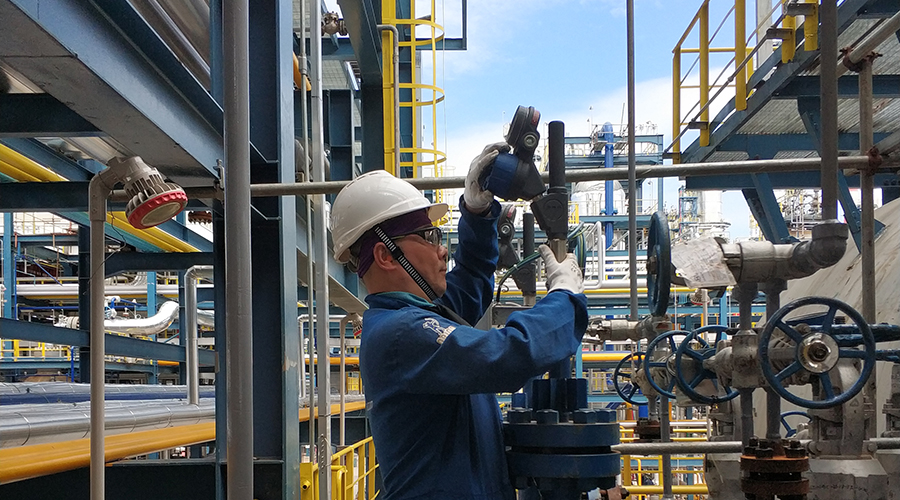
AMETEK LMS engineer installing a Magnetrol® branded Modulevel® displacer level transmitter.
Compared to torque tubes, the LVDT / range spring technology has proven to be more resistant to vibration, providing a more stable output resulting in better linearity and repeatability. Other factors contributing to the success of LVDT / range spring displacer transmitters include the linear structure of the physical design as opposed to the rotational torque tube. This design contributes multiple benefits, including reduced long-term maintenance costs; a smaller installation footprint for facilities with confined spaces; and the ability for the transmitter to be removed without de-pressurizing the tank.
The last factor, being able to perform maintenance or replacement of the transmitter without shutting down the process, results in increased uptime and plant profitability. The transmitter itself is an important element in the system, capable of advanced diagnostics while providing extreme ease-of-use through an intuitive user interface with quick-start menus to get processes up and running in a timely fashion. Make no mistake, these old displacers are “smart” transmitters built upon years of feedback and experience in the field.
Another basic, yet important, traditional method for level measurement has been through visual indication of the liquid level. Providing visual indication becomes more complex in the process industries where extreme properties and corrosive environments come into play. Nevertheless, visually inspecting the level is a technique that is still often used during walk-throughs, process start-ups, or to provide a degree of redundancy alongside other level instrumentation in applications such as storage tanks, separators and boilers.
Whether it be petroleum refineries or power plants, sight glass gauges are the most prevalent method of visual indication. However, users familiar with sight glass gauges may encounter problems such as breakage, leaks, or bursting particularly at high pressures and temperatures. In addition, the visibility of sight glasses can be poor and often affected by moisture and corrosion.
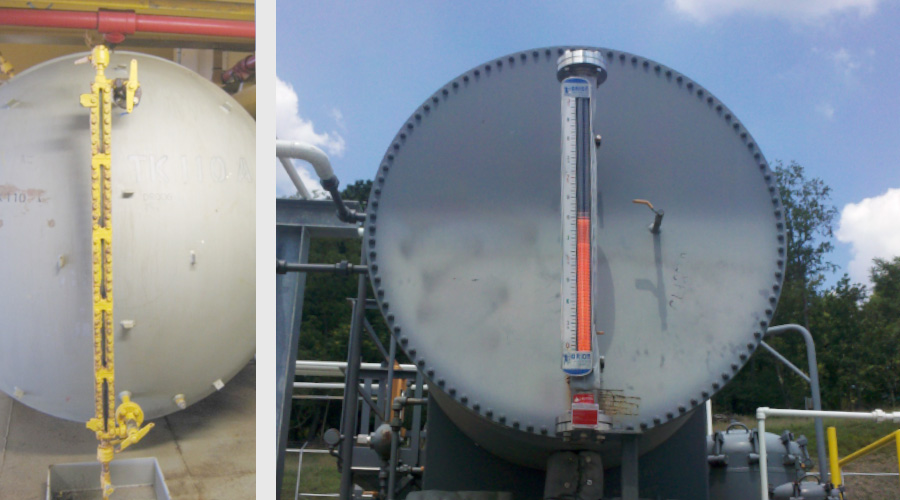
Sight glass gauge vs an Orion Instruments® branded Atlas™ magnetic level indicator.
An alternative technology used in place of sight glasses and now commonly specified in greenfield and brownfield projects is the magnetic level indicator (MLI) or magnetic level gauge. MLIs utilize a magnetized float inside of a chamber, which is isolated from a visual indicator and mounted to the outside of the process or storage vessel. The indicator has enclosed flags or a shuttle that are magnetically coupled to the magnets inside the float. The float follows the liquid level inside of the chamber, providing a clear representation of the liquid level as the indicator flags flip or the shuttle moves with the float.
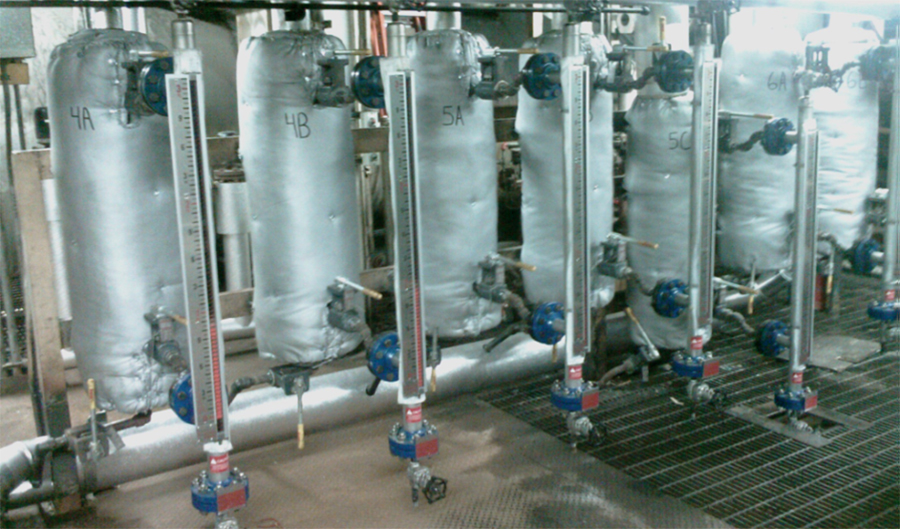
Boiler feedwater application upgraded from sight glass assemblies to Orion Instruments® branded Atlas™ magnetic level indicators.
One of the biggest differentiators with MLIs from sight glasses is the isolation of the visual indicator from the chamber and therefore the application media, eliminating the ramifications of these fluids coming into direct contact with the indicator. The viewing window of the indicator is often produced using a polycarbonate, providing better shatter/impact resistance compared to glass as well as reduced UV sunlight exposure. There will be process temperature limitations when using polycarbonate, where glass is still required at extreme high temperatures. Other parts of the MLI can be provided in various plastic constructions for chemical compatibility purposes including the chambers and floats. When adding up these differences and evaluating typical repair costs of sight glass gauges, including the seals/gaskets, glass kits and labor for removal and replacement, it amounts to thousands of dollars in maintenance compared to MLIs. This does not include the negative impact to plant revenue and profitability due to process downtime during sight glass repair.
An additional benefit of MLIs is the ease of implementing level transmitters or switches if an output proportional to the liquid level is required in addition to the visual indication. This can be beneficial as a measure of redundancy or if it is simply desirable to output the tank levels into a PLC or DCS. The most common level transmitters supplied through MLI designs are Guided Wave Radar (GWR) and Magnetostrictive.
Both GWR and Magnetostrictive technologies can be deployed using a dual chamber design, having the advantage of isolating the level transmitter from the MLI if maintenance must be performed on the transmitter. Alternatively, single chamber designs are available allowing both visual indication and continuous level output. This can be accomplished by externally mounting a Magnetostrictive probe to the outside of an MLI chamber (utilizing the same float for measurement) or installing a GWR probe directly into the chamber. In the case of GWR, a probe is installed parallel to the MLI float and separated by a baffle plate inside the chamber. The use of GWR provides an additional degree of redundancy, as the GWR transmitter operates independently from the float (if the float gets stuck or damaged) and conversely there is no effect on the MLI if the level transmitter signal becomes lost.
Alternatively, or in addition to level transmitters, level switches can either be clamped to the side of the MLI chamber (also operating off the float) or installed into the chamber using ultrasonic switches. Of course, switches provide an on/off detection for low and/or high levels as opposed to continuous level measurement from a transmitter.
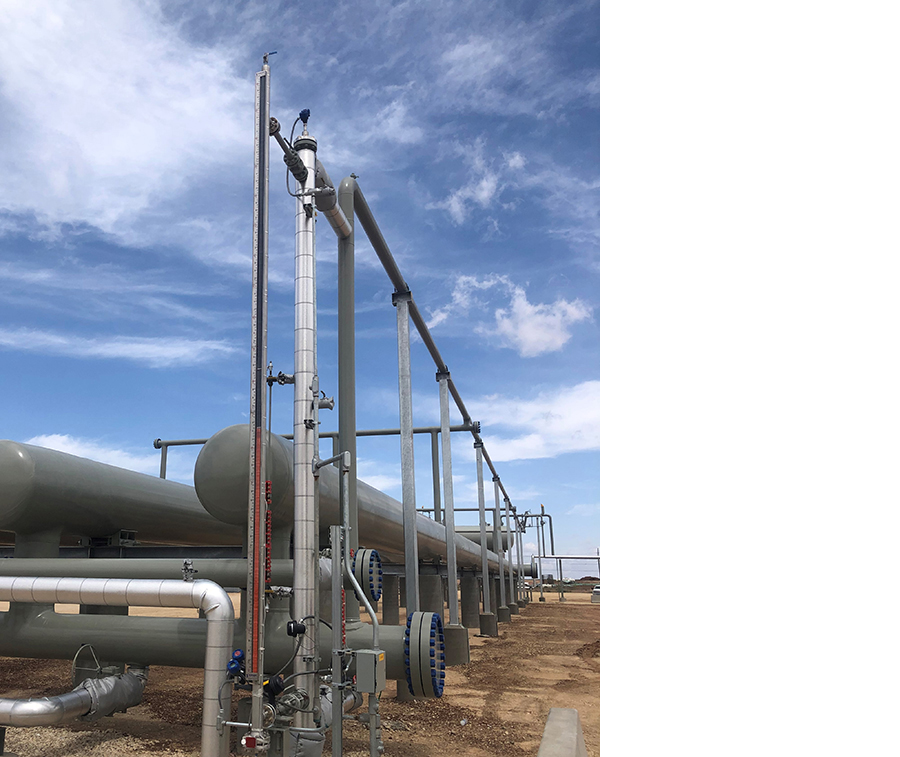 Magnetrol® branded Eclipse® 706 GWR transmitter installed next to an Orion Instruments® branded Atlas™ MLI with a Jupiter® JM4 magnetrostrictive level transmitter (midstream gas processing).
The prevalence of these mechanical-based technologies still in use today prove not only their reliability at the outset, but their continued refinement through the years to keep them in a competitive position against many newer level instrumentation technologies. And based on the comfort and familiarity they provide users all over the world in some of the most demanding process industry applications, chances are they will continue to remain top-of-mind when specifying level instrumentation in the next generation of industrial facilities to come.