





- September 7, 2022
Technologies for Liquid Interface Level Measurement
The need for interface level measurement arises whenever immiscible liquids–those incapable of mixing—reside within the same vessel. The lighter material rises to the top and the heavier material settles at the bottom. In oil production, for example, water or steam is used to extract oil from a well. Well fluids then route to production separators where they settle into their primary constituent parts as a hydrocarbon over water interface. Water may also be used as a transport medium or a cleaning agent and forms an interface which is later extracted.
Interfaces are commonly found in the diverse separation processes that are essential to every industry. Separation recovers additives and solvents, extracts impurities, and routes media into different processing channels.
Though our emphasis is on liquid-liquid interface, interfaces also form between liquid and solids, liquid and foam, or liquid and a gas—such as vapors or gases that are used in tank blanketing.
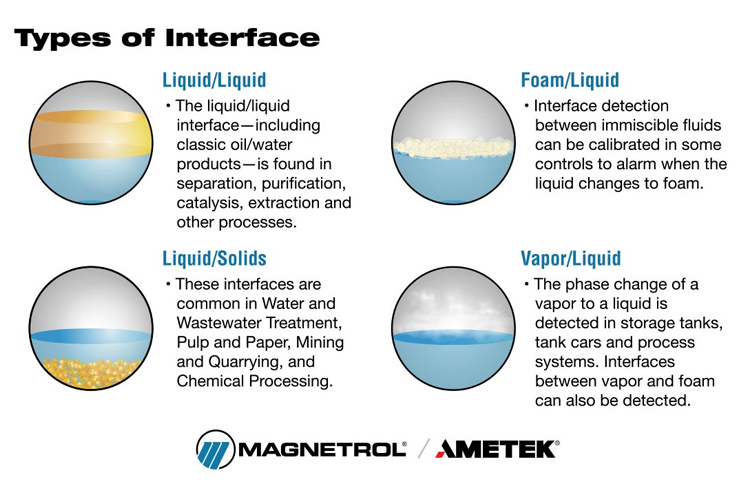
Immiscible liquids meet along an interface layer where they undergo some amount of emulsification. This emulsion layer (also called a rag layer) may form a narrow and precise boundary; but more frequently it is a broader gradient of mixed liquids. Generally, the thicker the emulsion layer, the greater the measurement challenge. As knowing the position of a process interface is necessary for maintaining product quality and operational efficiency, the interface should be measured and controlled by precision level switches or transmitters. Though at least 20 different types of liquid level measurement devices are available today, only a few are suitable for accurate and reliable interface level measurement.
Interface Measurement:
The dielectric constant (ε) of the interface media is critically important for GWR. As shown in the illustration at right, the upper dielectric should be between 1.4 and 10, and the dielectric difference should be greater than 10. The typical oil and water interface application shows the upper, nonconductive oil layer being 2, and the lower, very conductive water layer being 80. Eclipse measurement is suitable where the interface is clean and distinct, and the depth of the emulsion layer is shallow.

Measurement Principle:
Similar to GWR, a physical probe is utilized with a float riding along the outside diameter of the probe on top of the liquid. A low-energy pulse travels the length of a magnetostrictive wire that resides inside of the probe and a return signal is generated from the precise location where the magnetic field of the float intersects the wire (i.e., the liquid level). The elapsed time between the generation of the pulse and the return of the acoustic signal is measured to provide real-time and highly accurate level data.
Interface Measurement:
In these instances, the float can be weighted based on the specific gravities of the two primary liquids being separated. Magnetostrictive is particularly useful for tracking the bottom of thick emulsion layers.
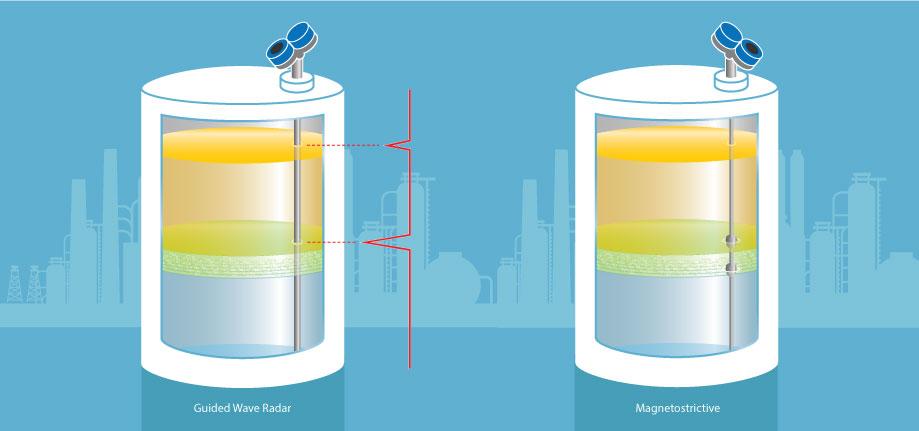
GWR WITH SIGNAL REFLECTIONS DOWN PROBE AND A DIRECT-INSERTION MAGNETOSTRICTIVE TRANSMITTER MEASURING EMULSION LAYER
Measurement Principle:
Movement of the interface level along the length of the displacer causes the precision range spring to extend or compress. This causes the movement of the core within a linear variable differential transformer in the Digital E3 Electronic Modulevel resulting in a digital or analog output. In a Pneumatic Modulevel, this causes the movement of a magnetic ball which guides the magnet carriage resulting in a pneumatic output change.
Interface Measurement:
This technology is widely used for interface service because it will typically track the middle of the emulsion layer.
Measurement Principle:
Switches using thermal dispersion technology detect heat transfer which reduces the temperature difference between two sensors; one sensor is for reference and the other is heated to a temperature above the process temperature. The temperature difference is greatest in air, then decreases when cooling occurs due to a change in flow rate and/or media. The electronics compare the electrical signal from the sensors against the set point to provide a relay actuation.
Interface Measurement:
The Thermatel TD1/TD2 and TG1 switches have been designed and engineered for level, flow or interface detection. When used as an interface level switch, the set point can be adjusted to detect the difference in thermal conductivity between two liquids. Water-based liquids have a high thermal conductivity while organic materials (oil) have a lower thermal conductivity.

Magnetrol has produced a special applications brochure featuring these and more interface level measurement technologies, with an overview of technology specs, process capabilities, and transmitter options. Download the brochure today and learn more about the benefits and applications of each technology.
Interfaces are commonly found in the diverse separation processes that are essential to every industry. Separation recovers additives and solvents, extracts impurities, and routes media into different processing channels.
Though our emphasis is on liquid-liquid interface, interfaces also form between liquid and solids, liquid and foam, or liquid and a gas—such as vapors or gases that are used in tank blanketing.
Immiscible liquids meet along an interface layer where they undergo some amount of emulsification. This emulsion layer (also called a rag layer) may form a narrow and precise boundary; but more frequently it is a broader gradient of mixed liquids. Generally, the thicker the emulsion layer, the greater the measurement challenge. As knowing the position of a process interface is necessary for maintaining product quality and operational efficiency, the interface should be measured and controlled by precision level switches or transmitters. Though at least 20 different types of liquid level measurement devices are available today, only a few are suitable for accurate and reliable interface level measurement.
Level Measurement Technologies
Here are some of the most reliable technologies for interface level measurement. The information presented describes the technologies as they pertain to Magnetrol® level instrumentation:
Guided Wave Radar - Eclipse®
Measurement Principle: Eclipse is based on Time Domain Reflectometry. TDR transmits pulses of electromagnetic energy down the wave guide, or probe. When a pulse reaches a liquid surface that has a higher dielectric constant than the air in which it is traveling (dielectric constant of 1), the pulse is reflected. Ultra-high-speed timing circuitry provides an accurate measure of liquid level. Even after the pulse is reflected from the upper surface, some of the energy continues along the length of the probe through the upper liquid. The pulse is again reflected when it reaches the higher dielectric lower liquid.Interface Measurement:
The dielectric constant (ε) of the interface media is critically important for GWR. As shown in the illustration at right, the upper dielectric should be between 1.4 and 10, and the dielectric difference should be greater than 10. The typical oil and water interface application shows the upper, nonconductive oil layer being 2, and the lower, very conductive water layer being 80. Eclipse measurement is suitable where the interface is clean and distinct, and the depth of the emulsion layer is shallow.
Magnetostrictive Transmitters - Jupiter®
Measurement Principle:
Similar to GWR, a physical probe is utilized with a float riding along the outside diameter of the probe on top of the liquid. A low-energy pulse travels the length of a magnetostrictive wire that resides inside of the probe and a return signal is generated from the precise location where the magnetic field of the float intersects the wire (i.e., the liquid level). The elapsed time between the generation of the pulse and the return of the acoustic signal is measured to provide real-time and highly accurate level data.
In these instances, the float can be weighted based on the specific gravities of the two primary liquids being separated. Magnetostrictive is particularly useful for tracking the bottom of thick emulsion layers.
GWR WITH SIGNAL REFLECTIONS DOWN PROBE AND A DIRECT-INSERTION MAGNETOSTRICTIVE TRANSMITTER MEASURING EMULSION LAYER
Displacers Controller and Transmitter - Modulevel®
Measurement Principle:
Movement of the interface level along the length of the displacer causes the precision range spring to extend or compress. This causes the movement of the core within a linear variable differential transformer in the Digital E3 Electronic Modulevel resulting in a digital or analog output. In a Pneumatic Modulevel, this causes the movement of a magnetic ball which guides the magnet carriage resulting in a pneumatic output change.
Interface Measurement:
This technology is widely used for interface service because it will typically track the middle of the emulsion layer.
Thermal Dispersion - Thermatel®
Measurement Principle:
Switches using thermal dispersion technology detect heat transfer which reduces the temperature difference between two sensors; one sensor is for reference and the other is heated to a temperature above the process temperature. The temperature difference is greatest in air, then decreases when cooling occurs due to a change in flow rate and/or media. The electronics compare the electrical signal from the sensors against the set point to provide a relay actuation.
Interface Measurement:
The Thermatel TD1/TD2 and TG1 switches have been designed and engineered for level, flow or interface detection. When used as an interface level switch, the set point can be adjusted to detect the difference in thermal conductivity between two liquids. Water-based liquids have a high thermal conductivity while organic materials (oil) have a lower thermal conductivity.
Magnetrol has produced a special applications brochure featuring these and more interface level measurement technologies, with an overview of technology specs, process capabilities, and transmitter options. Download the brochure today and learn more about the benefits and applications of each technology.

Interface in the Field
To learn more about interface measurement challenges and the technologies available to more accurately monitor interface, download our interface white paper.
Related Articles

October 15, 2025
AMETEK Magnetrol USA LLC Appoints TechStar LLC as Exclusive Channel Partner for Oklahoma

March 28, 2025
New Partnership Serving The U.S. Midwest Region

March 10, 2025
The New Old-Fashioned: Enhancing Traditional Level Measurement Techniques

February 24, 2025
Cut Monitor Technologies and Factors that Affect Their Performance

February 12, 2025
Plugged Chute Detection

January 20, 2025
Why Drexelbrook's Level Technology Stands Out Universally

November 7, 2024
BrightTEK™ – Transforming Remote Monitoring and Industrial Efficiency

October 23, 2024
Maximize ROI with Drexelbrook® branded Water Cut Meters: An Investment That Pays Off

October 10, 2024
Why Mechanical Instruments Remain Essential for Industrial Level Measurement

September 23, 2024
Case Study: Not All Guided Wave Radar Transmitters are Created Equal