





- December 11, 2023
Case Study: Magnetostrictive Technology Helps Refinery Measure Liquid-Liquid Interface
Improving Accuracy and Reliability
AMETEK LMS was able to assist a refinery in Germany with improving their interface level measurement in a separator. This refinery, one of the largest in the Bavarian region, produces around eight million tons of crude oil every year.
Their process equipment includes a petrol-soapy water interface, and salt from the soapy water enters the petrol after a certain period of time. This was causing a longer runtime of the petrol through the upper media. It also changed the dielectric value of the petrol. This changing value was causing malfunctions in the interface level measurement system they were using at the time—sometimes up to a 20% mismatch of the interface level. The instrumentation failed six times in a period of two years.
We suggested the use of magnetostrictive technology to monitor the liquid-liquid interface. Magnetostrictive level measurement uses a low-energy pulse that travels the length of a wire. A return signal is generated from the precise location where the magnetic field of a float intersects the wire. A timer precisely measures the elapsed time between the generation of the pulse and the return of the acoustic signal. Each cycle occurs ten times per second, providing real-time and highly accurate level data.
AMETEK LMS installed the Jupiter JM4 magnetostrictive transmitter in the application. The Jupiter JM4 was able to measure the interface more precisely than the previous level transmitter, as the density of the petrol was not affected by the salt in the same manner as the dielectric. No interface measurement is identical, so having a breadth of level technologies to choose from is critical. In this case, relying on a technology with floats that utilizes buoyancy principles provided improved interface level measurement. Since installation of the Jupiter JM4 eight months ago, there have been no level instrumentation failures and the magnetostrictive technology has assisted in preventing water from entering equipment downstream of the separator.

Interface in the Field
To learn more about interface measurement challenges and the technologies available to more accurately monitor interface, download our interface white paper.
Download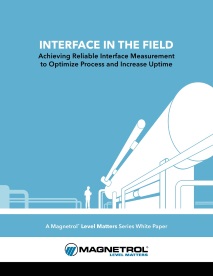
Related Articles

Flow Technology Joins AMETEK Level Measurement Solutions

AMETEK Magnetrol USA LLC Appoints TechStar LLC as Exclusive Channel Partner for Oklahoma

New Partnership Serving The U.S. Midwest Region

The New Old-Fashioned: Enhancing Traditional Level Measurement Techniques

Cut Monitor Technologies and Factors that Affect Their Performance

Plugged Chute Detection

Why Drexelbrook's Level Technology Stands Out Universally

BrightTEK™ – Transforming Remote Monitoring and Industrial Efficiency

Maximize ROI with Drexelbrook® branded Water Cut Meters: An Investment That Pays Off
