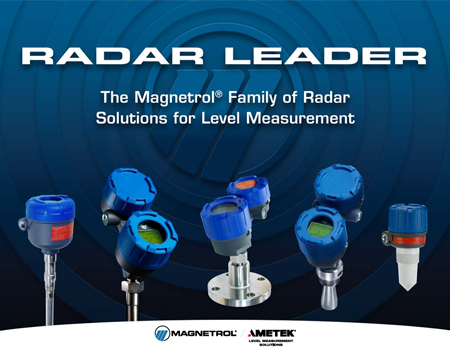





Assessing your level instrumentation needs correctly is essential for process efficiency and performance. To do this, it’s important to have an understanding of the many liquid level sensing technology options available – as well as the advantages and disadvantages of each, relative to the application.
In this post, we’ll discuss application considerations and configuration characteristics of Non-Contact Radar. These considerations apply regardless of whether the device is operating using Pulse Burst Radar or Frequency Modulated Continuous Wave (FMCW).
The Three Ds
Radar applications are influenced by three basic conditions:
- The dielectric of the process medium
- The distance, or measuring range of the application
- A variety of disturbances that attenuate or distort the radar signal
The dielectric constant dictates the reflectivity of the process medium:
- Highly conductive liquids (water-based) result in strong signal reflections.
- Insulating materials (hydrocarbon-based) result in smaller signal reflections.
The distance, or measurement range, is a function of the selected antenna, the dielectric constant of the media, and the presence of signal interference.
Disturbances caused by turbulence, foam, false targets (interior tank obstructions causing false echoes), multiple reflections (reflections from off the tank roof), or a high rate of level change, can weaken, scatter, or multiply radar signals. Very high and very low liquid levels can also be problematic.
Signal Processing
Advanced signal processing helps manage common disturbances, such as:
- False echoes caused by obstructions or multi-path reflections from sidewalls (1)
- Turbulence generated by agitators or aggressive chemical reactions (2)
- A layer of light to medium-density foam (3)

Radar’s signal processing function is critically important because radar exhibits interference effects similar to those that affect light. It is the quality of a device’s signal processing that separates today’s leading-edge radar transmitters from others. Most disturbances mentioned above can be readily managed by advanced signal processing capabilities, where true levels can be extracted from false targets and other background noise.
For this reason, our Magnetrol® branded radar products (can also track high rates of change that have been impossible with other loop-powered radar transmitters. Although these products feature powerful false target recognition and rejection routines, minimizing false target reflections is significantly affected by proper installation and orientation.
Antennas
The transmitter’s antenna transmits and receives the radar signal. Pulse Burst Radar transmitters can utilize a variety of dielectric rod and horn types or an encapsulated horn antenna. The maximum measuring range of the instruments is chiefly dependent upon the instrument’s capabilities, dielectric constants, and the degree of turbulence in the process media.
Installation
Using a Magnetrol branded Pulse Burst Radar products as an example, a typical installation procedure provides the key steps for mounting, wiring, and configuring transmitters. Transmitters typically come configured from the factory, but some models (such as the PULSAR and Model R82 devices) can be reconfigured in the shop at any time.
A HART® remote unit, such as a HART communicator, can be used to provide a communication link. When connected to a control loop, measurement readings shown on the transmitter will be displayed on the communicator. The communicator can also be used to configure and troubleshoot the transmitter.
Benefits
Pulse burst radar instrumentation is engineered to measure a wide variety of liquid media in diverse process conditions, from calm product surfaces and water-based media to turbulent surfaces and aggressive hydrocarbon media. As a non-contact device, these products avoid complications such as coating by viscous media or corrosive attack from aggressive chemicals. The greater the measuring range, the more pulse burst radar proves itself to be an economical solution compared to extended probe lengths.
Radar technology is virtually unaffected by the presence of vapors or air movement within a vessel’s free space. Changes in specific gravity, conductivity, and dielectric constants also have no effect on measurement accuracy. As a 100% electronic instrument, the absence of moving parts translates into low maintenance costs. As a two-wire, loop-powered device, power requirements and installation are greatly simplified.
For more information on our Non-Contact Radar products, download our Radar Solutions Brochure below.