





- January 22, 2024
6 Key Features to Consider When Choosing Guided Wave Radar Technology as your Level Measurement Solution
All process industries require the ability to safely and accurately measure level in critical applications. This task, however, can be complicated by a variety of factors, including process media that have varying characteristics, or those containing corrosive vapors, foam, buildup, agitation, bubbling or boiling.
Guided Wave Radar (GWR) technology, which is the operating principle utilized by the Eclipse® Model 706 transmitter from AMETEK LMS, provides true level and interface control for applications across many process industries, including petroleum refining, electric power generation, chemical manufacturing, water and wastewater, pulp and paper, pharmaceutical processing and food and beverage. To ensure that the optimal solution implemented, it is important to know some of the innovative features that the most reliable GWR solutions offer.
This blog post will discuss 6 key features that one should consider when deciding on a GWR transmitter for level measurement.
1. Signal Performance
While many GWR options on the market today promote the amplitude (size) of the transmitted high frequency signal sent down the probe, a far more important parameter for reliable level measurement in difficult applications is the overall signal-to-noise ratio (SNR). The Eclispe Model 706 features an innovative and patented design concept (called Diode Switched Front End) that can dramatically reduce the impact of noise in the system, thus improving overall GWR transmitter performance. This new circuit design completely isolates the transmit path from the receive path, thereby maximizing receiver sensitivity and impedance matching.

2. Complete Line of Probes
Probe choice is critical to the success of any GWR installation. Look for a GWR transmitter that offers an extensive line of dedicated coaxial, rigid single and flexible cable probes to handle a variety of level challenges.
Many GWR devices feature probes that have a transition zone at the top where interacting signals can affect the linearity of the measurement or result in a loss of signal. The Eclipse Model 706 offers overfill safe probes, which have a predictable and uniform characteristic impedance across the entire length of the waveguide. This allows the GWR transmitter to measure accurate levels, to within specification, all the way up to the process flange without any non-measurable zones at the top of the probe.

3. Advanced Diagnostics
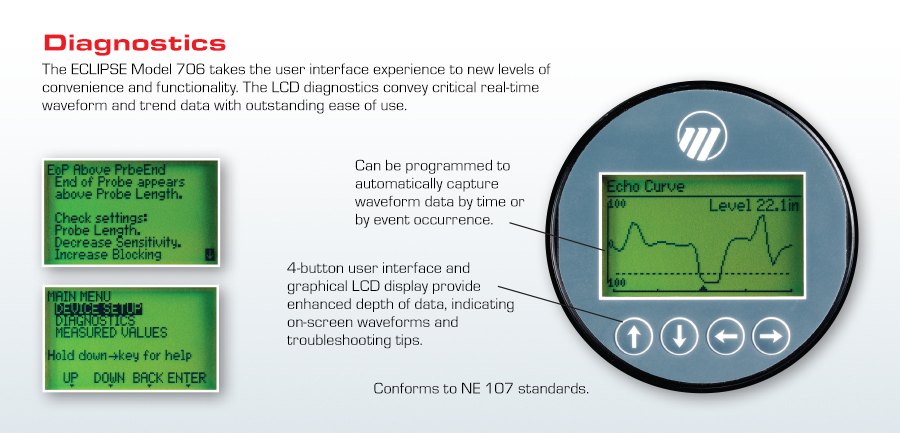
Look for those GWR transmitters on the market that offer advanced diagnostic capability, such as having the ability to save echo curve and diagnostic information based on Time (using an on-board clock) or Event (such as Loss of Echo or Low Echo Strength). The transmitter should have the ability to store a number of echo curves in its on-board memory, which can then be downloaded for troubleshooting.
Newer GWR devices also meet the NAMUR NE 107 standard. This relatively new standard allows the user to categorize diagnostic indicators in a way that suits their specific needs. The more advanced GWR transmitters incorporate this diagnostic scheme to allow much greater flexibility for the sophisticated user.
4. Output Types
Typical GWR devices provide an analog 4-20 mA signal with HART®, FOUNDATION fieldbus™, Profibus PA or Modbus digital communication output.
5. Convenient Pre-Configuration
Some GWR transmitters can be supplied “pre-configured” from the manufacturer. One step closer to plug-and-play, a pre-configured device allows one to virtually take the transmitter out of the box, apply 24 VDC to it and walk away, thereby greatly reducing installation time. Look for the manufacturer that offers this service at no additional cost.
6. Advanced Installation Capabilities
While most GWR transmitters are mounted directly onto the probe, some can be remote mounted up to 12 feet (3.6 meters) away from the probe to meet the needs of applications that may involve high temperature or vibration – or to simply increase ease of viewing for technicians. Some GWR units, like the Ecclipse Model 706, also offer a quick-disconnect probe coupling that eases installation and servicing by allowing full 360° rotation of the transmitter housing.

To gain a deeper understanding of the key features to consider when evaluating a Guided Wave Radar Technology Solution, feel free to reach out to us directly, or you can access our comprehensive Radar Solutions Brochure by downloading it from the link provided below.

Radar Solutions Brochure
How can you serve a world of different customers with different applications from different industries? AMETEK® Magnetrol does it with a true family of radar transmitters for all different needs. This brochure will introduce you to our Eclipse GWR and Pulsar Radar solutions. You’ll learn why the Magnetrol family is trusted wherever and whenever performance, safety and reliability matter.
DOWNLOAD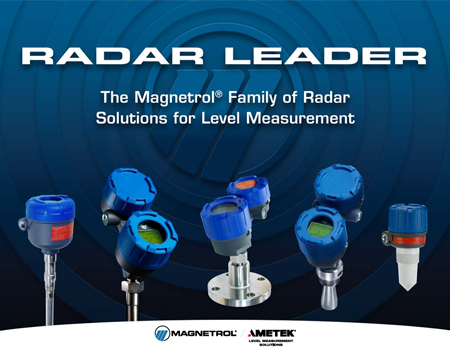

AMETEK Magnetrol USA LLC Appoints TechStar LLC as Exclusive Channel Partner for Oklahoma

New Partnership Serving The U.S. Midwest Region

The New Old-Fashioned: Enhancing Traditional Level Measurement Techniques

Cut Monitor Technologies and Factors that Affect Their Performance

Plugged Chute Detection

Why Drexelbrook's Level Technology Stands Out Universally

BrightTEK™ – Transforming Remote Monitoring and Industrial Efficiency

Maximize ROI with Drexelbrook® branded Water Cut Meters: An Investment That Pays Off

Why Mechanical Instruments Remain Essential for Industrial Level Measurement
Case Study: Not All Guided Wave Radar Transmitters are Created Equal