





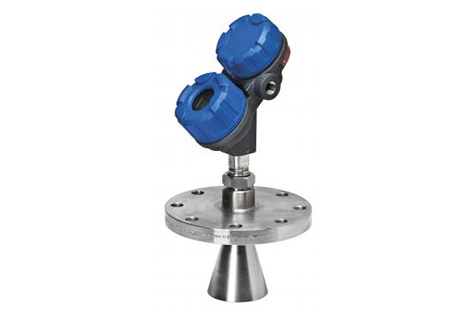
Pulsar® model R96- 6 GHz non-contact radar transmitter
The Pulsar® Model R96 is a loop-powered, 24 VDC, non-contact radar level transmitter. It has a longer measurement range, improved diagnostics and is easier to use than most loop-powered radar transmitters.
Technology
Non-Contact Radar
Non-Contact Radar level transmitters are offered with various operating frequencies, each having their own set of advantages.
There are two basic types of Non-Contact Radar transmitters, regardless of the frequency of operation:
- Frequency Modulated Continuous Wave (FMCW)
- Pulse Burst Radar
FMCW devices transmit a continuous signal with a constantly changing frequency down toward the process medium. The detected difference in frequencies between the transmitted signal and return echo is proportional to the distance.
Pulse Burst Radar transmitters, the older of the two types, emit short bursts of energy to the surface of the process medium, and incorporate ultra-high-speed timing circuitry to measure the transit time of the reflected signal. Distance is then calculated utilizing the equation:
Distance = C x Transit Time/2, (where C = Speed of Light)
Non-Contact Radar level transmitters are offered with various operating frequencies, each having their own set of advantages.
There are two basic types of Non-Contact Radar transmitters, regardless of the frequency of operation:
- Frequency Modulated Continuous Wave (FMCW)
- Pulse Burst Radar
FMCW devices transmit a continuous signal with a constantly changing frequency down toward the process medium. The detected difference in frequencies between the transmitted signal and return echo is proportional to the distance.
Pulse Burst Radar transmitters, the older of the two types, emit short bursts of energy to the surface of the process medium, and incorporate ultra-high-speed timing circuitry to measure the transit time of the reflected signal. Distance is then calculated utilizing the equation:
Distance = C x Transit Time/2, (where C = Speed of Light)

-
Features
-
Applications
-
Operating principle
-
Approvals
-
Downloads
Settings
- Performance not process dependent (changing specific gravity and dielectric have no effect)
- 6 GHz operating frequency offers superior performance in the tougher applications of turbulence, foam, and heavy vapors
- Antenna designs to +400 °F (+204 °C)
- Range up to 130 feet (40 meters)
- Quick connect/disconnect probe coupling allows vessel to remain sealed
- SIL 2 capable with Safe Failure Fraction (SFF) = 92.7% (FMEDA available upon request)
- PACTware™ PC software interface with new improved DTM.
Options
- HART® 7.1 and Foundation fieldbus™ digital communications
- 316 stainless steel dual compartment enclosure
- 4" and 6" horn antennas
- Polypropylene and Teflon® rod antennas
- Antenna nozzle extensions

| ATEX | Ex d, Ex ia, Ex n |
|---|---|
| CSA | XP, IS, NI |
| FM | XP, IS, NI |
| EAC (GOST) | Ex d, Ex ia, Metrology |
| IEC |
Ex d, Ex ia |
| SIL |
SIL 2 (1oo1) |
Other approvals are available. Consult factory for more details.
-
Approvals and certificates
API 2350 Overfill Prevention
Lorem ipsum dolor sit amet, consectetur adipiscing elit. In rutrum congue blandit. Integer non iaculis est. Nunc aliquam leo et libero tempor, eget pellentesque velit auctor. Nulla vestibulum nisi sit amet metus tempus, non blandit neque molestie.
-
Instruction manuals
Chemical Processing
Lorem ipsum dolor sit amet, consectetur adipiscing elit. In rutrum congue blandit. Integer non iaculis est. Nunc aliquam leo et libero tempor, eget pellentesque velit auctor. Nulla vestibulum nisi sit amet metus tempus, non blandit neque molestie.
-
Product catalogs
Food and Beverage
Lorem ipsum dolor sit amet, consectetur adipiscing elit. In rutrum congue blandit. Integer non iaculis est. Nunc aliquam leo et libero tempor, eget pellentesque velit auctor. Nulla vestibulum nisi sit amet metus tempus, non blandit neque molestie.




Related Articles

AMETEK Magnetrol USA LLC Appoints TechStar LLC as Exclusive Channel Partner for Oklahoma

New Partnership Serving The U.S. Midwest Region

The New Old-Fashioned: Enhancing Traditional Level Measurement Techniques

Cut Monitor Technologies and Factors that Affect Their Performance

Plugged Chute Detection

Why Drexelbrook's Level Technology Stands Out Universally

BrightTEK™ – Transforming Remote Monitoring and Industrial Efficiency

Maximize ROI with Drexelbrook® branded Water Cut Meters: An Investment That Pays Off

Why Mechanical Instruments Remain Essential for Industrial Level Measurement

Case Study: Not All Guided Wave Radar Transmitters are Created Equal