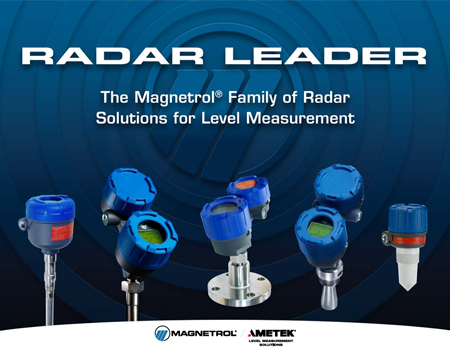






Deciding what instrumentation to use for a specific application will depend on the application's nature and on other factors such as cost and availability. Four of the most important factors to consider when selecting radar level transmitters for any application are performance, diagnostics, versatility, and ease of use.
Our Magnetrol® brand produces two types of radar level transmitters: Guided Wave Radar (GWR) and Non-Contact Radar. Both transmitters have characteristics that include these four important factors. Here’s how the Eclipse® Model 706 GWR and the Pulsar® Model R80 non-contact radar transmitters meet crucial needs for level measurement applications.
 Eclipse® Model 706 Guided Wave Radar
Performance
The Eclipse Model 706 is virtually unaffected by extreme process conditions, including temperature, pressure, specific gravity, and dielectric. With a superior signal strength and a signal-to-noise ratio almost 3 times that of the competition, it can be utilized in the most challenging applications across all process industries. Using the Eclipse Model 706, a plant can obtain reliable and repeatable measurement with less downtime.
Diagnostics
In addition to an automatic waveform capture feature, the Eclipse Model 706 tracks and saves real-time and historical data about device performance to help guide users to pinpoint issues if they arise. The device features an LCD display that outputs real-time field intelligence without the need for an instruction manual.
Versatility
A broad probe offering allows the Eclipse Model 706 to be used in a wide variety of process conditions and connections.
Ease of Use
The Eclipse Model 706 can be delivered preconfigured, which means plant operators can take it out of the box, attach two wires, and walk away knowing the transmitter is ready to measure.
Pulsar® Model R80 Non-Contact Radar
Performance
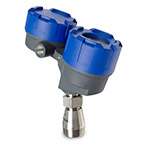
The Pulsar Model R80 features an 80GHz signal, with a shorter wavelength that offers smaller antennas, a narrower beam, and improved accuracy. This gives it improved performance in the most demanding process conditions. It also comes with volumetric configurations to help you set up the device for your precise needs. These configurations feature nine common tank shapes as well as a strapping table for uncommonly shaped vessels.
Diagnostics
As with the Model 706, the Pulsar Model R80 has automated echo capture that saves an echo curve based on key diagnostics, such as loss of echo. An expanded event history shows when and why the echo curve was triggered. This can help plant operators keep track of their operations, even when they may not be present when the diagnostic event occurred. Up to 20 configuration and diagnostic events can be viewed in chronological order for the most in-depth troubleshooting insights.
Versatility
The Pulsar Model R80 can be used in tanks up to 30 meters tall, including those with mixing blades, and applications with turbulence. It has 4 horn sizes available for use in punishing conditions and difficult applications. Small antennas can be installed in process connections as small as 3/4” NPT.
Ease of Use
The extremely small beam angle allows for installation in tight spaces, and the transmitter features a setup wizard that explains the configuration process step by step, with real-time help text built in.
More Information
For more information on the Magnetrol branded product line of radar level transmitters and how to choose the best transmitter for your application,download our Radar Solutions Brochure below.